


Last updated on 1 April 2026
Time passes and some memories resurface
October 31, 2023: yesterday I had the flu vaccine, and on 10.11.2023 at 10:00 AM, I will receive my sixth Covid vaccine.
I do not know how it will be, but up until the fifth, I always received the full dose (not the booster) of the Moderna vaccine.
Today I feel as if I have been hit by a semi-truck.
It is 12:40 AM and I cannot sleep; lying down, I struggle to breathe. I raise the head of the bed and sit up; it has not solved the problem, but it is better.
The cough is testing my physical body, but not my mind; they are two individuals traveling at distinct paces from one another.
With every breath, my chest hurts; it feels as if the air has to travel a much longer distance to reach my lungs. In that stretch, the little air I inhale disperses somewhere or perhaps is absorbed by something else, but not by my meager lungs.
My mind, however, is afraid; it thinks about everything I have been through, about the Advance Directives in case I lose the capacity for discernment and am unable to express my will—a document I have drafted and left with my wife and her cousin (and of which I am certain).
But if something happens to me suddenly, what do I do?
I am not afraid of dying, but I am terrified of suffering, of going through that experience again, of having that hunger for air again that my body could not satisfy.
The mind races, and during those thoughts, the first months after sedation came back to me.
In those days, it felt as if I were wearing a garment that did not belong to me.
The body was no longer mine; it was an entity that had traveled a long and dismal journey without me.
It was no longer my physique; I did not know, I did not remember, I had not felt what the body instead showed me and wanted me to see.
A hard and at times mournful path that had tested it more than once, a wandering that had drained it of all the energy it possessed. It had been left abandoned and defenseless, without energy, without the strength to perform simple actions like moving a finger, a muscle; no sound came from its vocal cords anymore.
It no longer had the will to live and fight; it had had to do so for too long and too many times. It was time to rest and regain the energy it had had to spend in all those challenges for survival.
This, I did not know.
I remembered a functioning body that had given me much satisfaction and that I could and had tested multiple times without any problem; it had never disappointed me and had never rejected my orders.
I did not know him, he did not understand me, and I did not understand him; we were two strangers placed there, side by side, without even having been introduced.
Yet both had to fight a hard and difficult battle, a battle that had to be fought alongside each other and not against each other.
Instead, he seemed to be fighting against me; I did not know that this stranger had already had to fight many battles alone before allying with me.
I did not know him and he did not speak to me, he told me nothing about himself; we were two strangers placed there by someone with a power beyond our will and without any regard for our safety.
What would the future be with this broken-down companion with little energy to spend?
I do not know; nearly three years have passed, but I still do not have an answer to this question.
It is better now; the breathing is more relaxed, each breath is longer and deeper.
It is time to rest not only the body but also the mind!
Sleep, it is 2:23 AM!
Yes, but in this chapter, I wanted to tell you about my memories during the period spent in intensive care at Cardiocentro Ticino.
To be honest, I do not have many memories; I recall moments of lucidity to which, however, I cannot assign a chronological order.
Today is January 17, 2024; three years ago at this time, I was in the middle of this adventure. As you may have read, in those days I had been transferred to the intensive care unit of the Moncucco Clinic.
Let us return to my awakening after my body had to overcome all the various challenges to become an entity devoid of energy and functionality; it was a body placed there, lying in a bed, inert and immobile.
The Awakening
In the first days after awakening, my wife came to visit me; my eyes were half-closed, I was lifeless, I absorbed her words passively, without any interest.
On one hand, it was pleasant; I felt dissociated from reality and worries. Nothing interested me; I was at the mercy of my fate in a passive way. I did not have the strength to move a finger, let alone react to what was happening to me.
On that occasion, my wife Mirna said to me: “As soon as you are better, we will go on vacation to a magnificent place.”
I dreamed of a Caribbean sea, where I had never been, a postcard-perfect sea.
My dream was and is French Polynesia, the island of Taha’a (I fell in love with it after seeing it in a documentary).
Unfortunately, however, my physique had returned to that of a “child.”
A one-year-old child begins to walk; I did not!
A one-year-old child begins to eat independently; I did not!
A one-year-old child begins to speak; I did not!
A one-year-old child learns to grasp objects; I did not!
I could not speak because I had a tracheostomy, but even if I could, my body did not have the energy to do so and my mind did not feel the need.
I could not move, shift, or simply turn over in bed.
I did not have the strength to lift my arms; I could move the fingers of my left hand, but they were trembling. The weakness… and also my morale made everything difficult, impossible.
The X-ray machine
Almost every day, generally in the morning, I heard the sound of an electric motor; it was the machine they used to take X-rays of my lungs.
I did not have to do anything, also because I could not.
They would move me, “photograph” me, and then leave with their motorized device.
I remember that one day the device did not work as it should; it was out of battery, and the technician was cursing at whoever had used it before him and had not put it on charge.
This noise was a “routine” that allowed me to orient my mind within the day.
I often waited for it impatiently to understand if it was morning or afternoon; evening, on the other hand, I could recognize by the absence of light outside the window and the lights in the room. It had become my “biological clock.”
The tracheostomy
During the period when I had the tracheostomy, no sound came from my mouth, although in some cases my wife read my lips and managed to understand a few words.
Several months after I returned home, she told me that the first time she came to visit me, I shouted at her voicelessly, “Call a taxi and take me home.”
I remember nothing of that day, nor of that visit.
I recall that I communicated with gestures using my left hand; I would point my index finger toward my throat to indicate to the nurses that I wanted to be suctioned through the tracheostomy.
Periodically, several times a day, I had to do this because phlegm would settle and make breathing difficult for me.
They would insert a small tube into the tracheostomy hole and go down to suction the various fluids that had settled.
There were nurses who were more hesitant or perhaps had less experience who limited themselves to suctioning “on the surface”; in those cases, I did not feel much improvement. But when they suctioned deep down, I felt as if I were coming back to life and afterwards I felt more relaxed.
It was not pleasant, but it was certainly better than when the tracheostomy became clogged and I had to strain to get air into those lungs battered by Covid.
After a few days… or perhaps weeks, during one of my wife’s visits, one of the nurses—I don’t remember who—said: “Let’s try putting on the speaking valve so you can have a chat with your wife.”
My wife and I looked at each other in amazement.
I immediately signaled “OK”; finally, I would be able to communicate.
My wife was a bit frightened by this unexpected and sudden proposal; she said to the nurse: “But does the doctor know?”
Reassuring her, the nurse told her that there would be no danger and that he would be just a few meters away.
They connected this valve to my tracheostomy and, as if by magic, I heard my voice, even if it was not my usual voice.
Perhaps the valve, or perhaps my energy levels, did not allow the sound of my voice to come out as it did before the illness, but regardless, I was able to speak, to communicate, to express myself… it was one of my first successes!
It lasted only a few minutes; speaking exhausted me very quickly, as if I were chopping wood or lifting bags of cement, but that is how it was: a few words and I was exhausted, feeling the need to rest and sleep.
So I did; I said goodbye to my wife, closed my eyes, and went to sleep, happy and satisfied to have overcome my first challenge.
The nasogastric tube
I do not know exactly when, but one day, while washing my face, Paul accidentally pulled out my nasogastric tube. I hardly noticed, and I was pleased—maybe I could start tasting something by mouth.
Instead, after a few minutes, he returned with a bag and various materials; he told me that he would have to put it back in because I was not ready to eat.
Now I was conscious, and inserting that cannula from the nose down to the esophagus caused me incredible pain; I can still feel the burning and the obstacles the tube encountered on its path to its destination.
Paul, with his Dutch accent, told me “swallow so it goes down better,” but the tube struggled to go down… not to be repeated.
From 그 moment on, every time someone approached my face, I was terrified they might remove that cursed tube.
That tube was used to feed me; I remember the bags that were connected and the strange aftertaste that rose from my stomach, a taste that was not pleasant at all.
Some medications were also administered via the nasogastric route, in particular the therapy against leukemia.
I remember a small electric grinder in which they placed the medications, grinding them until they became a powder that they dissolved in a liquid; they would draw it up with a huge syringe and then inject everything through my nose.
The pleasant part was when they injected Coca-Cola to “flush” the tube after administering the medications; in that moment, I felt a pleasant sensation. To be clear, I did not taste it, but I could perceive the freshness of something going down through my throat and into my stomach.
After a few days, while trying to blow my nose, I pulled out the nasogastric tube myself. It was exhausting to reach my nose with my trembling left hand, and the tremor caused me to yank the tube out. I could not use my right hand; my dominant hand was not moving.
I was desperate; I did not want to go through that ordeal once more, but I could not express it except through tears and a few signs with the fingers of my left hand.
Fortunately, the nurses noticed and spoke with the doctor to determine if it was necessary to reposition the cannula or not.
Fortunately, they did not put it back; it meant starting to eat and drink.
I was overjoyed.
But my enthusiasm was soon dampened; before eating, I had to have the consent of the speech therapist.
Most of the medicines were still administered intravenously, but some, like the one for leukemia, were crushed and dissolved in water with a thickener and given to me with a teaspoon, as with children when they learn to eat. I still could not bring my hand from the glass to my mouth. Furthermore, the tremors would have caused most of the thickened liquid to end up everywhere except in my mouth.
The bed with side rails
I was lying on my back facing up; I saw the white ceiling with a window to my left that allowed me to see what was happening outside. But to be honest, I did not have a great interest in seeing what was happening outside; my thoughts were clouded. It seemed to me that I was on an island where thoughts did not exist, fear did not exist, pain was not felt, and time did not matter. I struggled to distinguish day from night and personally did not care to be aware of it.
One thing that disturbed me, however, was the bed rails, which I could not grab to turn onto my side. After many hours spent supine, where the only movements I could perform were moving my head to the right and left and my left arm, which I could drag across the sheets to the outer edge of the bed. Yes, on March 7 (described in the inpatient diary), I had begun to move my left hand.
This had already been a first sign of progress; then, as the days and weeks passed, I managed to move my arm as well.
The fact that I could move my arm gave me the conviction that I could grab the bed rail and, by pulling it toward myself, I could rotate my body and turn onto my side.
It was a pure illusion; I moved my arm, yes, but it was not yet able to overcome the force of gravity, let alone move a body—even though I had lost a lot of weight, I still weighed 52 kg.
I remember that the buttons to control the bed were on the rail, but even in that case, there was no question of being able to raise or lower the head of the bed; the rail was too far away, and furthermore, the tremor did not allow me to reach and maintain pressure on the button.
These difficulties demoralized me greatly; I was beginning to understand what kind of situation I had gotten myself into, and slowly I realized that I would not be able to return to the person I was before.
In fact, the nurses wrote in the inpatient diary:
“It is the first day I have cared for you and I am happy to see the good steps forward you have made; you are quite demoralized because you are beginning to realize the situation, but you continue to take small steps toward recovery.”
The transfer from bed to armchair
My body had not gotten up independently from the bed since January 12, 2021.
I was lifted thanks to the hoist, which allowed the nurses not to break their backs, even though my weight had decreased by over 25 kg. The sensation the hoist gave was not pleasant; I was in a bag suspended in mid-air and saw very little of what was happening to me, but that was how it was and I had to adapt.
Slowly, as the weeks passed, I began to have a little strength in my left hand, and then one of the nurses said to me: “Today we are trying a new technique; you will have to hug me intensely as if you were hugging your wife.” Initially, I did not understand, but then he approached and leaned down toward me, took my hands, and placed them around his neck. At 그 point he said to me: “Now hold your hands, I’ll do the rest; we’ll stand up and then rotate toward the armchair.” I was bewildered because the only muscles I could move were those of my left hand, and even with that, it’s not like I had monstrous strength. He said to me: “One, two, three, and go!”. He stood up with me hugged around his neck, turned, and gently placed me in the armchair.
His response was: “See, we made it!”.
For me, that day was a success; I no longer needed… or almost no longer needed that hoist.
In the following days, we still tried to use that technique to move me from the bed to the armchair and vice versa, but it did not always work; many nurses were afraid to lift me like that, others did not have the strength and therefore preferred to be in pairs, but in that case, the synchronization of movements in lifting me was difficult.
As time went by, however, I too learned to know my nurses and knew how to adapt to their lifting techniques. The important thing was to be able to get up for a few hours from that cursed bed and look around a bit.
On March 16, 2021, the nurses wrote to me: “Today you were in the armchair for more than 5 hours; for the whole day you did not need the ventilator, a high flow of air and oxygen was sufficient.”
Surely a success, a first step toward recovery? I had been in a hospital bed since January 12, and this was beginning to worry me. Furthermore, I knew that my parents were at the Clinica Luganese Moncucco; both were in intensive care and this worried me. I knew that my father had little chance of recovering, but for my mother, the doctors were optimistic; they had even extubated her.
This information of mine, however, dated back to mid-January and although I had a strange perception of time, probably due to the medications I was receiving, I began to think more and more about them and how they might be. As the days passed, this concern turned more and more into fear.
I asked the nurses if they had news of my parents, but they politely told me they were at the Cardiocentro and had no information about them. In hindsight, however, I came to know that everyone except me knew, but given my state, they did not want to burden me with further pain.
I learned of my parents’ death toward the end of March 2021; I learned it from my wife.
I suspected it because as soon as I brought up that subject or asked about them, everyone tried to change the subject or left.
I do not know if it was thanks to the medications or the weakness of the body, but I must say that at that moment the pain and regret were not so intense; finally I knew, but I still did not realize it.
The real pain and the sense of loss, however, were not long in coming; in the following months, when I had returned home, I began to realize what had happened to me and the loss. Before all this, my mother and father would visit us weekly; on those occasions, they would arrive with a crate of delicacies my mother had cooked and a few bottles of wine to enjoy the excellent food. They would stay for lunch until late afternoon before saying goodbye and returning to their nest, a small but nice apartment in Vacallo.
None of this would happen anymore; I would no longer see their faces, their behaviors when they argued because they disagreed on something—most of the time it was trifles or misunderstandings.
All this would no longer be, and will never be again!
The alarms – the blood pressure cuff and the oximetry sensor
I was awake; I saw and understood what was happening around me.
To be honest, I cannot say I was completely conscious; I still felt as if I were in a protective bubble. I felt no pain, and as soon as I said I felt pain or discomfort, they immediately rushed to me to try to solve the problem. I was a bit like the mascot of the intensive care unit; I had been with them for months now.
I remember I had the tracheostomy and they often had to suction me to clear the mucus and allow me to breathe better. As soon as I heard the gurgling through the tracheostomy, I would raise the palm of my left hand and they would immediately arrive to suction me; it had become almost a code signal that they understood instantly.
Despite this, I still had a lot of medical devices connected to my body and these were quite annoying.
I remember even today that the two most annoying devices were the blood pressure cuff and the oximetry sensor. During the day, it was bearable, but at night it was very irritating; every hour (I presume) it would start to inflate, and just as I was falling asleep, that gadget would compress my arm and wake me up.
If things went well, it was just the compression on the arm, but often some alarm would start ringing and shortly after the nurses would arrive. Among themselves they would say: “give him xx of NORA”; I always wondered what this NORA could be that was administered to me every time the alarm bell started ringing.
Now, after some questions and research, I have understood that NORA is the abbreviation for noradrenaline, a medication that primarily has these characteristics:
The effects of noradrenaline are mainly concentrated at the cardiovascular level.
Well known is its ability to increase heart rate and contractility, raising blood pressure through vasoconstriction.
In any case, that cuff that inflated regularly every hour, besides annoying me, allowed me to calculate how much time was left until morning.
Another device, not invasive at all but which annoyed me greatly, was the oximetry sensor.
It was attached to my finger 24 hours a day. My finger always felt sweaty, as if the skin could not breathe, so from time to time I would try to move it with the fingers that remained free, but as soon as I did, the alarm would start ringing. The same thing happened at night; if I happened to move my hand or fingers, the sensor would come off, causing me to wake up suddenly because of the alarm.
There were nurses who did not worry and as soon as the alarm rang they would arrive and check if the sensor was in its place, but there were also nurses who, after the first alarm, would take adhesive tape (or an adhesive bandage) and fix the sensor to me so it would not come off.
This bandage was very annoying; furthermore, it irritated the skin, as it remained stuck to my finger for many hours and in some cases even for an entire day.
But toward the end of my stay in intensive care, at least the blood pressure cuff was removed during the night. Much more comfortable, but there was a downside: I no longer had a way to determine what point of the night I was at. Now the only method was to look out the window and see the dawn beginning to illuminate my room… even if the view was not much.
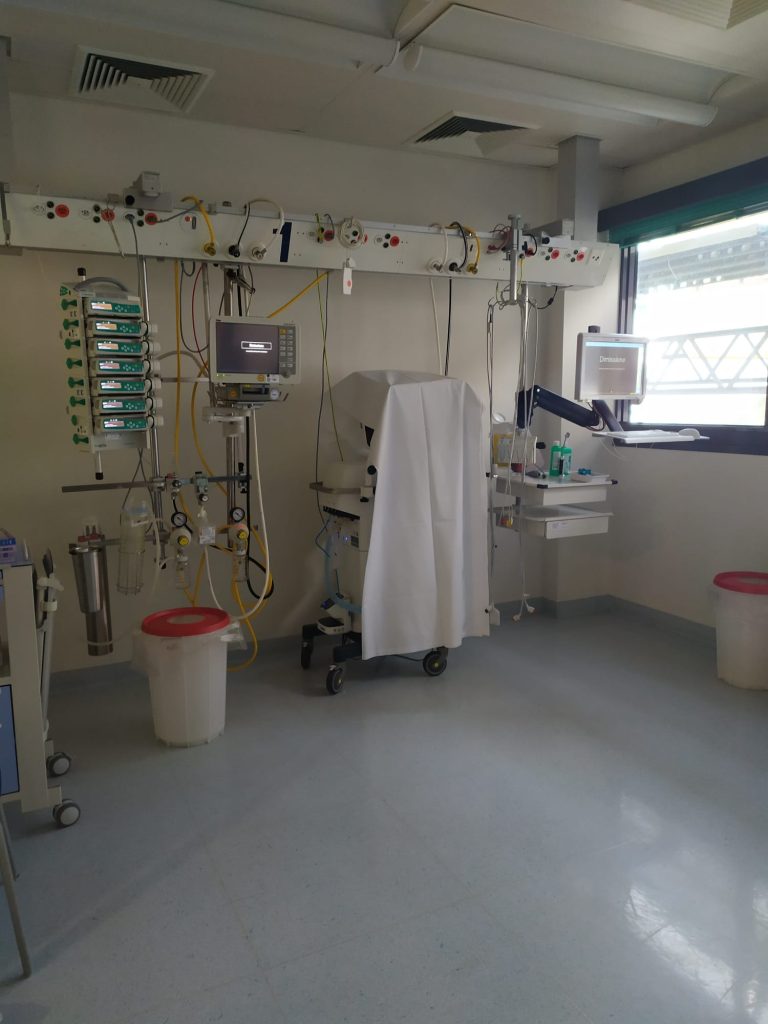
For now, that is all I remember; as soon as other memories surface, I will record them on this page.
Goodbye!