


Last updated on 1 April 2026
I had started the new school year (2020-2021) proud of having planned and organized everything in the best possible way.
For a few weeks, however, I had not been feeling well.
At night, I often had to get up because I was drenched in sweat; I had to change my shirt and sheets, but I wasn’t too worried as the temperatures were still summery, almost tropical. At least, that was my sensation.
As the days and weeks passed, however, I became increasingly tired and struggled to make it to the evening.
But even then, I blamed it on everything done in the months prior due to the pandemic; indeed, the workload and stress had been considerable.
I do not understand those who say working from home is more relaxing and manageable; in my case, there was a situation to resolve at every moment—a teacher, a student, or a parent to answer—and then I had to plan and carry out normal routine activities. In addition to being deputy director, and on that occasion acting director, I was also one of the campus IT specialists, and during that period the IT infrastructure was under great strain due to the remote learning that teachers had to conduct.
It was a Wednesday morning (October 21, 2020); I got up as I did every day around six in the morning, but I was very tired; it felt as though I hadn’t rested at all during the night.
I hopped onto my motorcycle and headed toward Chiasso, about thirty kilometers from home.
When I arrived at school, I dismounted the bike with difficulty and could hardly put it on the stand because I felt so exhausted.
On that occasion, I realized something was wrong; I went to the office and told the secretary that I was going back home because I didn’t feel well.
My intention was to go to my family doctor, whose office was a few steps from my house, and ask for a few days of sick leave to recover and return to work as usual.
The doctor performed a brief examination; given the situation, he took a swab and blood samples, and then told me to stay home in isolation until he had the results of the swab and the tests.
Around three in the afternoon, he called me and said he would come to my house because he needed to speak with me and give me the test results.
I wasn’t worried; I thought he wanted to come over to tell me I was positive for COVID and check if I had isolated myself from the rest of the family.
When he arrived, I saw that he seemed embarrassed, and after a short while, he told me that the tests showed an unusually high white blood cell count.
I didn’t understand what that meant; I thought it was something temporary, but shortly after, he told me that an ambulance would be coming to take me to the Civico Hospital for further investigation.
His decision seemed exaggerated to me, but in the end, he convinced me; he said it was for further testing and to verify his analysis more precisely.
I arrived at the hospital and between infusions, blood tests, an electrocardiogram… in short, they performed all types of analyses and investigations.
On that occasion, I overheard what the doctors and nurses were saying; there, I heard the word LEUKEMIA for the first time!
Until then, I thought it was something passing, treatable with a bit of paracetamol or a similar medication.
My family doctor had not uttered the word LEUKEMIA, but rather an unusually high white blood cell count.
I began to worry and think about what would become of me; until then, I had always known leukemia as a disabling disease with a high mortality rate.
I had to spend the night in the hospital, even though I initially did not agree.
They told me that if I stayed in the hospital, the next day I could be seen by a female hematologist from IOSI and receive more precise information regarding what was happening to me and what I would be facing.
Even the doctors at the Civico Hospital had not confirmed the diagnosis, but only hinted at the possibility that it was leukemia.
I spent a sleepless night thinking about all the possible scenarios that I and my family would face.
My children were still dependent on me; they were finishing their high school studies and had not yet defined their future.
Not knowing what their future would be like worried me and frightened me beyond belief.
The next day, the doctor explained that the tests showed this abnormal white blood cell count and that, most likely given such high values, I might have developed chronic myeloid leukemia.
What a big word… I didn’t like the term chronic at all; it meant I wouldn’t get well and that there was no hope.
But no! The doctor told me that the disease could have a slow course and could be “controlled” with specific medications.
In any case, to confirm the diagnosis, I had to undergo a BMB (Bone Marrow Aspiration and Bone Marrow Biopsy); the term was not inviting, and indeed, it was not pleasant at all.
On September 23, the diagnosis was “definitive”; we were waiting for the BMB confirmation, but by then it was a done deal.
My body was weak, and I felt like I was regressing instead of improving, perhaps also because I hadn’t started therapy yet.
To start therapy, I had to wait for the BMB results, and that took a couple of weeks.
In those weeks, besides being physically weak, my morale was also at rock bottom; I didn’t see a future, or at least I didn’t see it as I had imagined and desired it until a few days before.
Following this were the first certificates of inability to work, initially as suspected AML (Acute Myeloid Leukemia)—an acronym I didn’t initially know the meaning of—and later with the diagnosis of chronic myeloid leukemia.
The BMB confirmed the diagnosis, so I had to start therapy with Imatinib.
Initially, this medication caused me several problems: nausea, vomiting, joint pain, asthenia, skin rashes, and itching.
But after a few weeks of patience and endurance, the side effects began to subside.
Initially, I couldn’t drink alcohol, and this bothered me as I appreciated and still appreciate a good glass of wine (and in company, even more than one) while eating.
Being immunocompromised, COVID did not allow us to gather as a family, so giving up the glass of wine didn’t weigh on me too much.
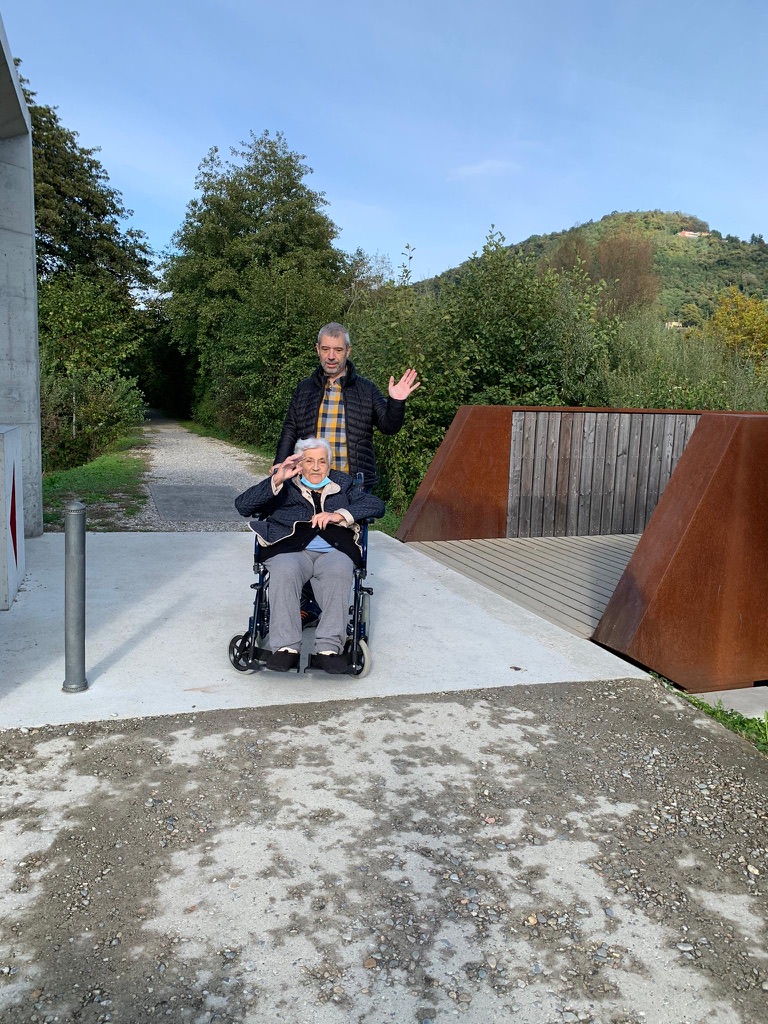
One of the few physical contacts I had during that period was with Grandma Terry (my mother-in-law); she also had to be very careful as she had several cardiac and other pathologies that made her very fragile and at risk of infection.
The pleasant weather of those months encouraged us to leave the house, so we took advantage of the beautiful days to take short walks in the surroundings.
Nothing comparable to the physical activities that occupied me in previous months and years, but equally pleasant to remember.
I remember that before the pandemic, I would leave home (Agno) and go to work in Chiasso by bicycle without any problem; once I arrived, I would go to the gym, have a shower, change clothes, and be ready to start the workday.
But soon I would again have the strong desire to sit around a table with my loved ones.
Risky? Irresponsible? Selfish?
In hindsight, I have asked myself this many times, but I have not yet found an answer.
In a few pages, you will understand the meaning of these questions of mine.
Like it or not, I had to live with the disease and with the risks and dangers to which it exposed me.
During that period, I was rather pessimistic, which, by the way, is one of my distinctive traits.
I didn’t feel well, and by then it had been more than a month since I had the energy and enthusiasm of the past to face challenges.
The Imatinib therapy was working from a hematological standpoint—the values and numbers were working—but my body was not saying the same thing.
I don’t know if it was the therapy or the disease; I felt tired and without energy, and over time I didn’t have the impression that things were changing much, even though the doctor was optimistic given the blood results.
At each visit, in addition to routine procedures such as temperature (due to COVID), pulse, blood pressure…, she would look satisfied at the computer screen and then turn it toward me, showing me a graph with a clear downward curve.
This curve gave her much satisfaction, or at least that was my impression—an impression, however, that my body did not share; it still felt fatigued and with little energy available.
I had to “accept” the fact that I was healing, even if physically and morally I did not feel that way.